 PersonaGamer
I still remember the first time I stepped off the train in Inaba and was greeted by that sleepy, rural charm. Last year, when Atlus finally confirmed Persona 4 Revival was in the works, my heart skipped a beat—not just because of the nostalgia, but because I know what modern remakes from this studio can deliver. We saw it with Persona 3 Reload and RAIDOU Remastered: Mystery of the Soulless Army. They walked that tightrope between reverence and innovation so gracefully. But here’s the thing: Persona 4 Revival has the chance to be more than just a faithful glow-up. It can fix the one part of the original that always felt at odds with its soul—the way we experienced Inaba itself.
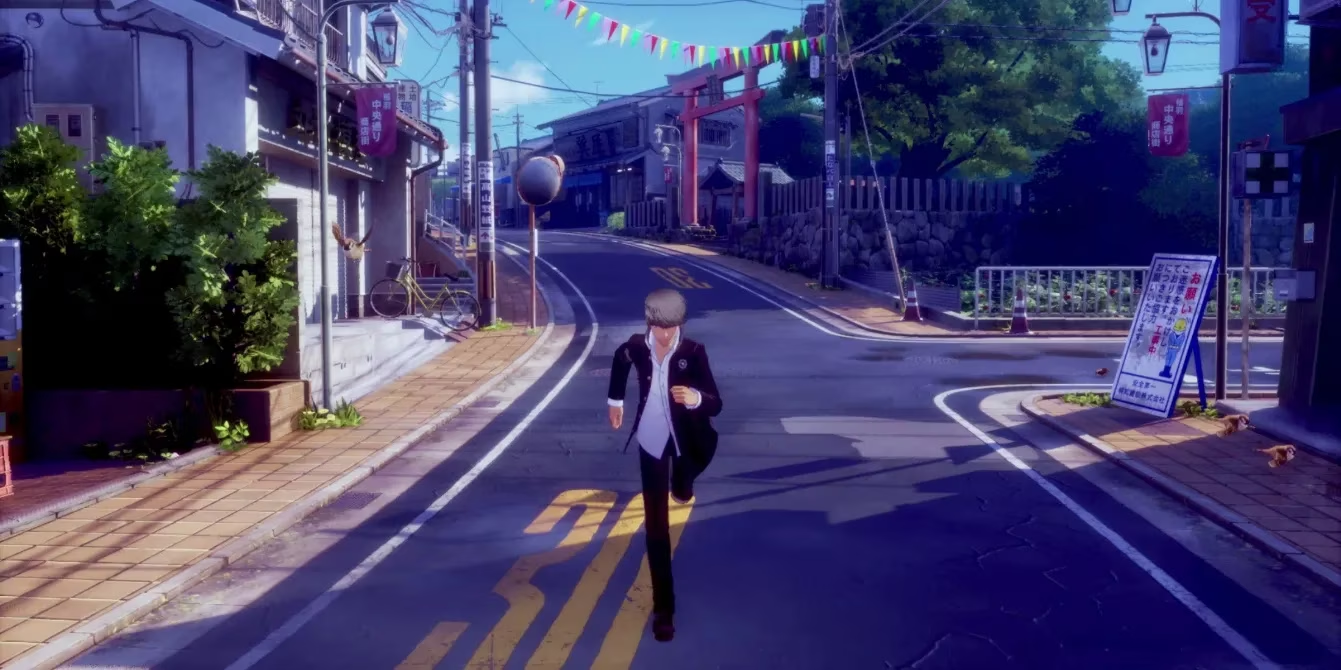
Let me explain. Inaba is supposed to be this intimate, tight-knit community where everyone knows your business, and the small-town vibe is the beating heart of the story. But if you play the original Persona 4 today, the world design doesn't quite live up to that promise. Sure, you can "go where you want," but the map is broken into disconnected slices—your house, the school, the shopping district, the floodplain. Each one is a self-contained screen, separated by loading transitions and menu-based travel. There’s no sense of a living, breathing town you can simply wander through. It’s more like a series of activity hubs stitched together with fast-travel menus, similar to what we got in the Mass Effect trilogy’s non-continuous hubs.
Compare that to Persona 5’s Tokyo. In P5, hopping on a subway to zip between Shibuya, Yongen-Jaya, and Kichijoji made total sense because the city’s sheer size demands that kind of abstraction. But Inaba? A small town where the whole map should feel like one walkable neighborhood? Suddenly, those hard borders between areas feel jarring. They rob the setting of its intimacy and make exploring more about selecting destinations from a list than actually being there. If Atlus wants to recapture the magic, Persona 4 Revival needs to treat Inaba as a continuous, condensed open world—one where you can stroll from your front door to the shrine and then up to Junes, all without hitting a single loading screen if you choose.
Imagine this: as you walk down the foggy streets, you hear the murmur of conversations from tiny shops, spot a stray cat near the Samegawa floodplain, and maybe bump into a classmate who’s in a hurry. These small, emergent moments would make Inaba feel alive in a way the compartmentalized original couldn’t. And I’m not talking about the vast, empty fields of some AAA open-world games. I’m thinking of something much denser and more deliberate—like Kamurocho in the Yakuza series.
Think about how Kamurocho works. It’s tiny by open-world standards, but every square inch is crammed with personality, side stories, minigames, and secrets. That’s the blueprint Persona 4 Revival should follow. Inaba could be filled with alleyway shortcuts you discover by chance, bulletin boards that lead to new Social Links, and weather-dependent events that only trigger if you’re in the right place at the right time. Suddenly, a rainy afternoon would be more than just a stat boost for fishing—you might see puddles reflecting the town’s lanterns while an NPC’s umbrella flips inside out, sparking a new side quest. The focus on a smaller, handcrafted space would let P-Studio stuff the town with meaningful content, not collectible clutter.
Going a step further, an open Inaba could also rebalance the game’s rhythm. In the original, daily life often boiled down to: choose an area from the map, watch a cutscene or minigame, repeat. If the world were seamless, you’d organically pass by the bookstore and remember to pick up a new book, or overhear a rumor that opens a dungeon floor. The pace would feel less mechanical, more like you’re actually spending a year in this town. And with 2026 being the age of ultra-smooth SSDs and instant loading, there’s no technical reason Atlus can’t pull this off without sacrificing performance.
Of course, some might worry that radical changes could mess with Persona 4’s identity. Persona 3 Reload proved that Atlus can modernize an experience without losing its soul—Reload brought P3’s moody, melancholic atmosphere into a crisp new engine while keeping the original’s DNA intact. But P4 Revival has a different kind of opportunity. Persona 3 got a remake that essentially injected the polish of Persona 5 into its bones. P4 can leap even further. It can remix the formula rather than simply update it. This franchise almost always skews urban: bustling Tokyo, the futuristic cityscape of Persona 2, the neon streets of Strikers. Inaba is a rare, beloved exception. As a rural, slice-of-life setting, it’s practically begging for a design that leans into exploration and slow-burn discovery—something more akin to a compact, modernized Boku no Natsuyasumi than a menu-driven life sim.
If Atlus plays it safe here, we’ll still get a beautiful, emotionally resonant remake—I have no doubt. But if P-Studio dares to tear down the invisible walls and let us get lost in Inaba proper, Persona 4 Revival could redefine what a modern Persona game looks like. After all, the best way to honor a game about forging bonds in a quiet town is to make that town a place we never want to leave—not because a menu won’t let us, but because we’re too charmed to even think about it.
Comments