 PersonaGamer
As a dedicated follower of all things Persona, I've watched countless character debates ebb and flow over the years. Yet, in 2026, one conversation seems to have achieved a remarkable longevity: the passionate, often heated discourse surrounding Persona 5's Makoto Niijima. Just when I think the discussion has settled, a new wave of opinions surfaces, reigniting the question that has divided the Phantom Thieves' fanbase for nearly a decade. What is it about the student council president that inspires such fervent loyalty in some, and such profound confusion in others? The recent online chatter I've witnessed has been some of the most polarized yet, compelling me to dive back into the heart of this enduring mystery.
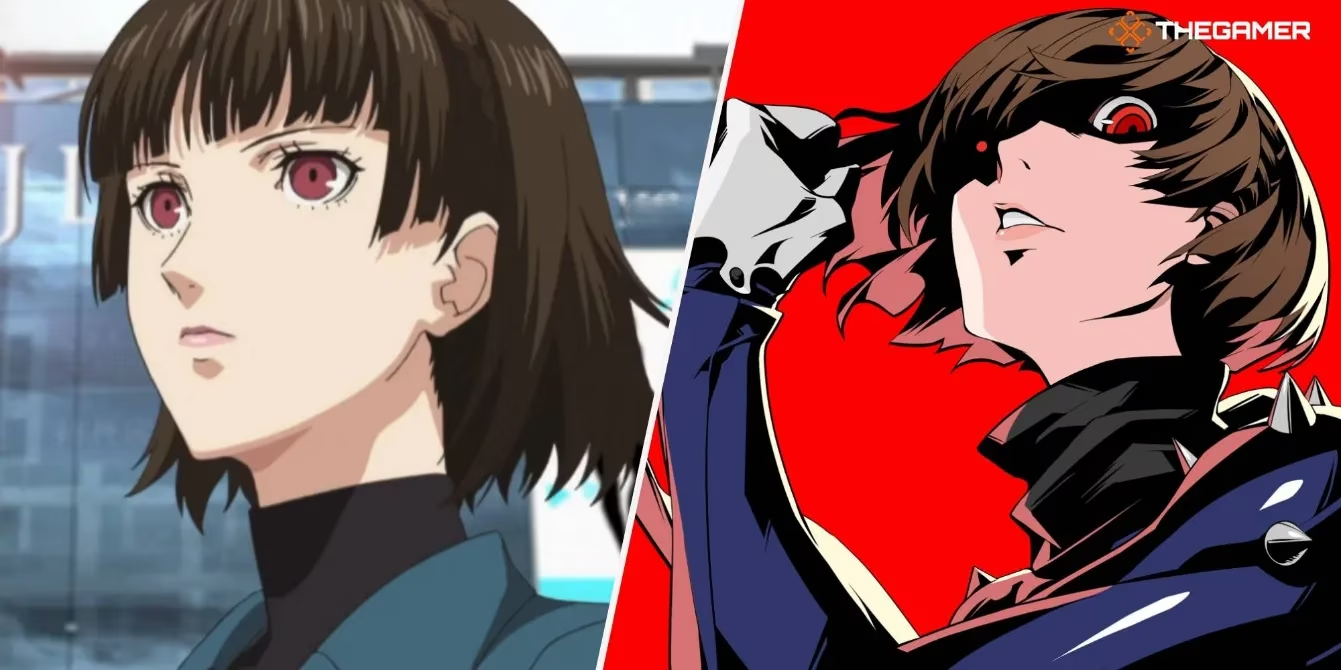
The Spark of Controversy: An Anonymous Critique
The latest chapter in this saga ignited, as so many do, on social media. An account operating under the enigmatic banner of "Persona Anonymous"—a platform known for its Phantom Thief-style secrecy—dropped a take that sent shockwaves through my timeline. Their core argument was blunt: "Makoto Niijima is the most wildly overrated character to come out of P5/P5R." The poster expressed a genuine bafflement, stating, "I'm not knocking anyone for liking her but I just don't get it." This simple declaration opened the floodgates for hundreds of replies, neatly dividing into camps of staunch agreement and vehement defense. It was a microcosm of the broader debate that has persisted since the game's release.
The Social Link Stumbling Block
Scrolling through the responses, a clear pattern emerged among those who share the "overrated" sentiment. A frequent and pointed criticism zeroes in on Makoto's Confidant storyline, the series' signature character development mechanic. One commenter summed it up with, "Genuine facts here, her SL puts me to sleep." Even I have to admit, I see their point. The narrative of navigating the petty drama of a friend's toxic relationship often feels disconnected from the high-stakes, rebellious energy that defines the rest of Persona 5. Is helping Eiko navigate her poor romantic choices truly the most compelling use of Joker's precious time? Furthermore, the requirement to max out the Charm social stat to progress feels like an arbitrary gate, a frustrating hurdle that isn't present to the same degree with other key characters.
What's fascinating, however, is that this critique isn't solely the domain of Makoto's detractors. I've noticed a semi-consensus, even among her supporters, that her Confidant arc is not the primary source of her appeal. This admission is crucial—it forces us to look elsewhere to understand her popularity. If not her one-on-one story, then what?
The Case for Queen: Narrative and Gameplay Powerhouse
This is where the defense mounts its most compelling arguments. Where Makoto's Confidant may falter for some, her integration into Persona 5's main narrative is arguably second to none among the playable cast. Her personal struggle is inextricably woven into the fabric of the game's central conflict. Her relationship with her sister, Sae Niijima—the relentless prosecutor—provides a continuous, emotionally resonant throughline that directly challenges the game's themes of systemic corruption and distorted justice.
Her conviction isn't just a character trait; it's the thematic engine of the Kaneshiro and Sae Palaces. Can we really imagine navigating those arcs without her driving sense of duty and moral compass? Her code name, Queen, isn't just for show; it reflects her role as the strategic heart of the Phantom Thieves. From a pure gameplay perspective, she's a powerhouse. Her balanced skill set, featuring both potent Nuclear attacks and crucial healing/support abilities, makes her a near-permanent fixture in most players' endgame parties. And let's be honest, her Persona transformation and that iconic motorcycle are simply peak style.
The Modern Landscape: Spin-Offs and Legacy
Nearly a decade on, the debate isn't confined to the original game. Makoto's presence in spin-offs like Persona 5: Dancing in Starlight, Persona Q2, and the mobile title Persona 5: The Phantom X has given players new contexts in which to evaluate her. Some argue that these appearances have fleshed out her character in enjoyable ways, showcasing different facets of her personality outside the pressure-cooker environment of the main plot. Others contend that if you didn't connect with her in P5, the spin-offs are unlikely to change your mind.
The mention of Persona 5: The Phantom X is particularly poignant in 2026. Despite the controversies that have swirled around that title, Makoto's implementation within it has often been highlighted as a positive, a familiar and well-executed element in an otherwise divisive package. This enduring relevance across multiple projects speaks to her foundational role in the Persona 5 universe.
Where Do We Stand?
So, where does this leave us? The divide seems to stem from what players prioritize in a character. If your primary metric is the depth and engagement of the personal Confidant story, Makoto might indeed fall short compared to characters like Futaba or Yoshizawa. But if you value a character's seamless integration into the core narrative, their thematic significance, and their combat utility, Makoto stands tall as one of Persona 5's most essential figures.
As one popular reply in the recent debate wisely stated, "I like her, but I'm not going to pretend there aren't valid reason[s] not to." This, I believe, is the healthiest perspective. The passion on both sides proves that Makoto is a character designed to elicit a strong response, not a bland one. She is complicated, sometimes frustrating, but undeniably central. Whether you see her as the overrated queen of popularity or the undeniable heart of the rebellion, her place in Persona history is secure. After nine years, the conversation itself is a testament to her impact. The real question is, will we still be debating this when the Phantom Thieves' 20th anniversary rolls around? Given the passion I see today, I wouldn't bet against it.
Comments